This study focuses on the determination of the impact of Nigeria’s textiles import restriction. Specifically, the study describes the structure of the global and Nigeria’s textile industries as well as the global value chain, and the policy environment surrounding the industry in a global and national perspective. It was conducted in 2013 with support from FCDO (formerly DFID).
STUDY OF THE IMPACT OF NIGERIA’S TEXTILE IMPORT RESTRICTIONS

Associated resources
A roundtable event on the potentials of exporting the services sector in Nigeria. At the Roundtable, it was noted that among business owners and exporters, there is little understanding of what services export entails. Many businesses engage in service exports but are not aware of this. Understanding the four modes of services – Cross border trade, Consumption abroad, Commercial presence, and Presence of natural persons – is important for business growth. To achieve this, stakeholders including the NEPC will need to conduct capacity building and sensitisation workshops for exporters, working with relevant business associations.
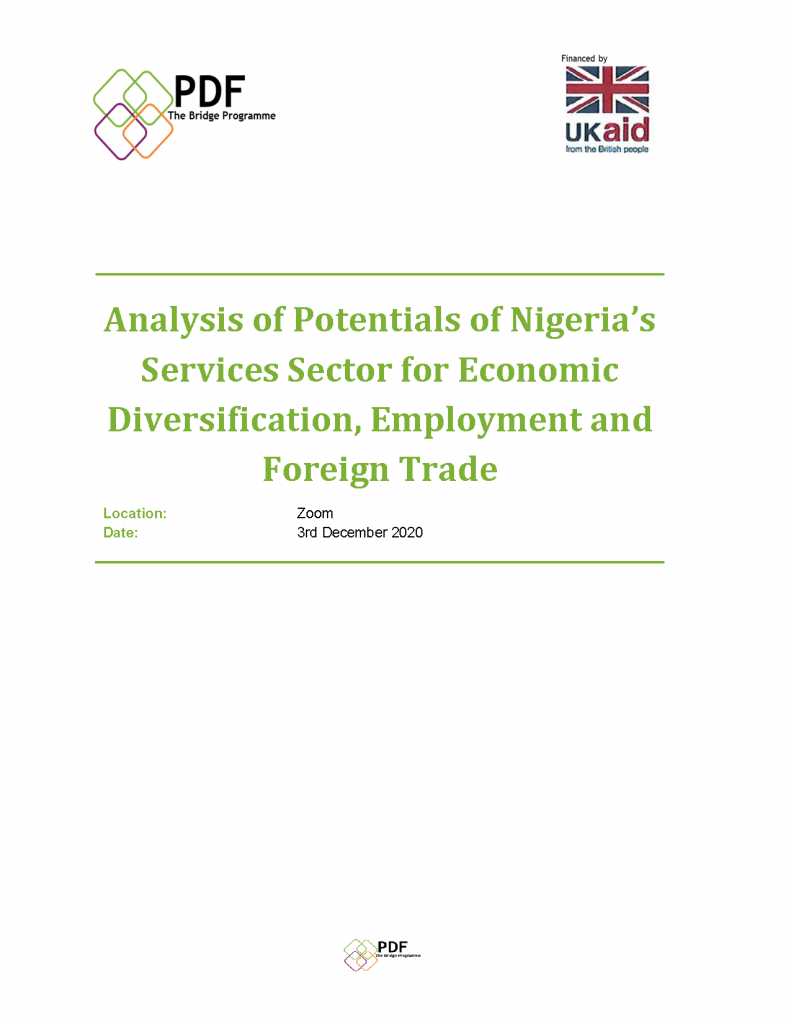
With the global COVID-19 pandemic came the need for local manufacturers to step up to the challenge and produce face masks, face shields, and PPEs due to dwindling supplies caused by high demand the world over. The support provided by government agencies to these entrepreneurs was critical, this in turn was derived from the technical advice supplied by the PDF Bridge programme under the Trade Policy Workstream through dialogues, studies, and roundtable events. The workstream focuses on non-oil exports by bringing underrepresented voices into economic policy and strengthening the participation of exporter groups in trade. The workstream engaged with representatives of Abia State Government during its dialogues particularly with the Director-General of the Abia State Marketing and Quality Management Agency (ASMQMA). This engagement led to increased capacity and redirection of strategy for the Aba Textile cluster in the production and distribution of finished goods. With help from the State Government’s agency on quality and standardization, Abia State Marketing and Quality Management Agency (ASMQMA), tailors generated an estimated $4-5million for the Nigerian economy from Abia State alone from the production of PPEs. This created a 110% increase in tailoring personnel.
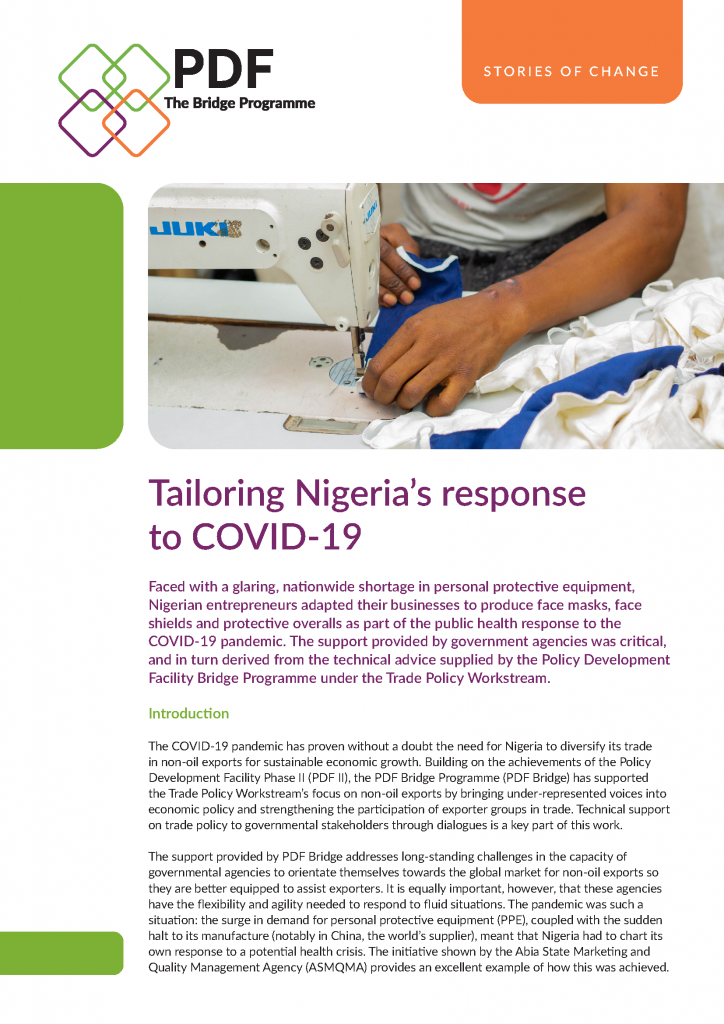
Micro Small and Medium-Scale Enterprises (MSMEs) are integral to the stimulation of developing economies as exploiting the full capabilities of MSMEs will improve trade competitiveness aimed towards achieving the objectives of the Africa Continental Free Trade Area (AfCFTA). PDF Bridge Programme recognises the role that MSMEs can play in the implementation of the AfCFTA; and is supporting the National Action Committee of the AfCFTA Secretariat by funding this study.
This study conducted by PDF with support from FCDO (formerly DFID) shows that women who engaged in cross border trade contribute to food security by trading food products from areas of surplus to areas of deficit. The paper reveals that depending on how this trade is organized, these women have the potential to contribute significantly to household earnings and resources. This empowers women by giving them financial independence and control of their own resources.
Against a backdrop of falling oil prices, the Nigerian government has woken up to its economic vulnerability to oil-related disruptions. This underscores the need for diversification to non-oil exports. PDF Bridge supported the drive towards growing non-oil export by supporting under-represented non-oil exporters through three strands of work: strengthening Nigeria’s ability to trade beyond its borders through the Network of Practicing Non-Oil Exporters of Nigeria (NPNEN), an export mentorship programme, which links experienced exporters with new and growing export businesses; and training sessions for micro, small and medium-sized enterprises (MSMEs) intending to export non-oil goods were held on; Market Entry Strategies, Understanding export documentation, Raising Finance for Export, Branding, and packaging for export. In addition, Roundtables were held on;
- Addressing Barriers to Access to Foreign Markets – An analysis of Spices & Herbs, Textiles & Garments, and Leather Products;
- Analysis and Impact of Export Expansion Grant on Export Potential, Market Access and Export Competitiveness in Nigeria;
- Improving Market Access through Digital Trade and;
- Analysis of Potentials of Nigeria’s Services Sector for Economic Diversification, Employment and Foreign Trade;
- Diversification and Non-oil Export Opportunities for Nigeria States Post-COVID19 Study